Ethan BakerPublications
Publications
Featured Publications
For a complete and up-to-date list of my publications, see my INSPIRE-HEP profile.
2026
Dark Photons in the Radio Sky: I. Resonant Conversions in Halos
Phys. Rev. D 114, 043013 · doi:10.1103/zpdq-b6t6
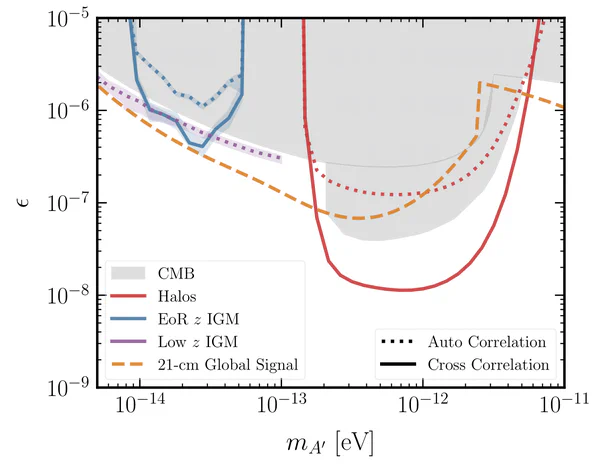
We compute SKA’s sensitivity to photon-to-dark-photon conversions in dark matter halos and find that SKA is likely to have leading sensitivity to dark photons over the mass range we consider.
Abstract
Mixing between dark photons and visible photons leads to substantial anisotropies in the cosmic microwave background due to resonant conversions of visible photons into dark photons in baryonic matter found in dark matter halos. In this work, we forecast the sensitivity of the Square Kilometre Array (SKA) to this signal. We find that SKA could be the first experiment to discover dark photons with a mass between $10^{-13}$ and $5 \times 10^{-12}$ eV and kinetic mixing parameter $\epsilon$ as small as $\sim 10^{-8}$ by cross-correlating their data with a low-redshift galaxy survey, potentially improving on the sensitivity from a similar analysis using Planck data by a factor of 4 in $\epsilon$. This improvement is largely due to an enhancement of the signal at low frequencies and the unique experimental advantages of radio telescopes such as small beam sizes.
2026
Dark Photons in the Radio Sky: II. Resonant Conversions in the Intergalactic Medium
Phys. Rev. D 114, 043014 · doi:10.1103/q492-rszq
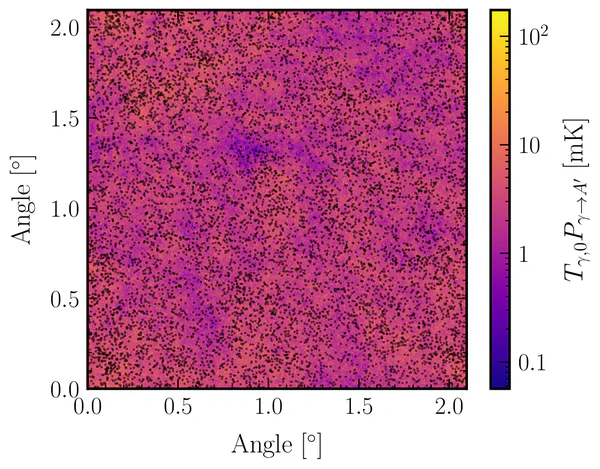
We compute SKA’s sensitivity to photon-to-dark-photon conversions in the intergalactic medium and find that SKA is likely to have leading sensitivity to dark photons over the mass range we consider.
Abstract
This is the second part in a pair of papers forecasting the sensitivity of the Square Kilometre Array (SKA) to dark photons, a highly motivated, simple extension of the Standard Model. Through a kinetic mixing term, visible photons from the cosmic microwave background can resonantly convert into dark photons, generating new temperature anisotropies in the sky. In this work, we detail the entire analysis pipeline that we use to compute SKA’s sensitivity, focusing on resonant conversions that occur in the intergalactic medium. We also discuss the sensitivity of 21-cm experiments to dark photons. Our results show that both SKA in combination with galaxy surveys and 21-cm experiments could discover dark photons with masses between $5 \times 10^{-15}$ and $5 \times 10^{-12}$ eV, and kinetic mixing parameter $\epsilon$ as low as $10^{-8}$.
2026
Radio Emission from High-Frequency Gravitational Wave Point Sources
arXiv:2606.09968 · doi:10.48550/arXiv.2606.09968
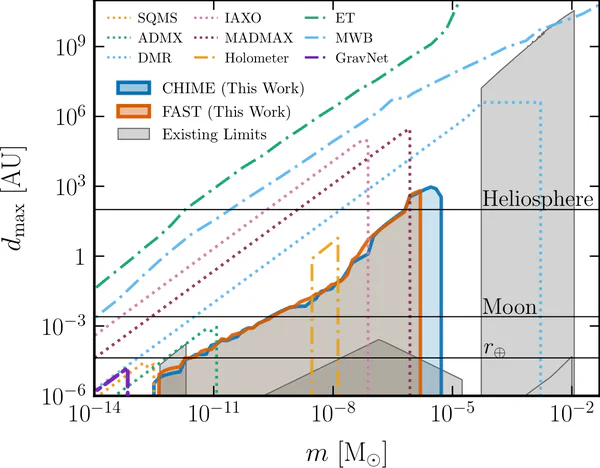
We show that radio telescopes are one of the best ways to look for high-frequency gravitational waves.
Abstract
High-frequency gravitational waves (HFGWs) in the MHz to GHz regime can convert into radio photons in the presence of astrophysical magnetic fields through the inverse Gertsenshtein effect. We show that existing radio telescopes like CHIME and FAST are excellent tools for detecting HFGW sources, significantly outperforming many existing experiments at detecting primordial black hole (PBH) mergers, the most realistic sources of transient HFGWs. Radio telescopes are also uniquely sensitive to sources of monochromatic HFGW emission, such as ultralight boson clouds formed through superradiance around PBHs, and are likely to have excellent sensitivity to generic sources of detectable HFGWs.
2026
spectroxide: A code package for computing cosmic microwave background spectral distortions
arXiv:2604.24838 · doi:10.48550/arXiv.2604.24838
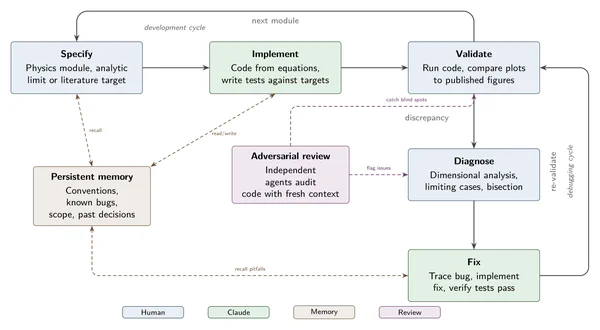
We present an open-source software package to compute CMB specctral distortions from energy and photon injection. The entire codebase was autonomously created with agentic AI tools.
Abstract
We present spectroxide, a code package for computing cosmic microwave background spectral distortions in which all $\sim 14,500$ lines of Rust code, Python interface, and $\sim 400$ automated tests were written by an AI assistant (Claude Code) under human physicist supervision. The solver evolves the photon Boltzmann equation under Compton scattering, double Compton emission, and Bremsstrahlung from $z\sim 5\times 10^6$ to the present, computing spectral distortions from arbitrary heat and photon injection within this redshift range. No fully open-source code of this kind is publicly available; we validate against analytic limits, published spectra, and publicly available precomputed Green’s function tables. We document the development as a case study in AI-assisted scientific computing, highlighting how domain expertise caught physics bugs (incorrect dimensional prefactors, near-cancellation errors) that evaded the full automated test suite, and provide recommendations for best practices in human–AI collaborative development of scientific software. We make spectroxide publicly available on GitHub.
2024
Cosmic Microwave Background Search for Fine-Structure Constant Evolution
Phys. Rev. D 109, 103529 · doi:10.1103/PhysRevD.109.103529
Abstract
In some extensions of the standard model of particle physics, the values of the fundamental coupling constants vary in space and time. Some observations of quasars hint at time and spatial variation of the fine structure constant $\alpha$. Here, the Bekenstein-Sandvik-Barrow-Magueijo (BSBM) model (which posits the existence of a scalar field driving evolution in the fundamental electric charge $e$) is tested against quasar and Planck satellite cosmic microwave background (CMB) data. In this model, variations in $e$ are coupled to the matter density through a factor $\zeta_{\rm m}/{\omega}$, which is related to electromagnetic contributions to nucleon masses, and the energy scale of new physics. Simulations conducted here do not support claims that the electrostatic contribution to $\zeta_{m}$ is completely shielded. Other common approximations used in BSBM field evolution are found to be adequate. Principal components of the CMB data with respect to variations in \alpha are used to obtain constraints of $\zeta_{\rm m}/{\omega}\lesssim 9.3 \times 10^{-9}$ for a massless field. A forecast anticipating the promise of the Simons Observatory (SO) CMB experiment shows that SO will be sensitive to values of $\zeta_{\rm m}/{\omega}\geq 2.2 \times 10^{-9}$.
2024
Lattice QCD Calculation of the Pion Distribution Amplitude with Domain Wall Fermions at Physical Pion Mass
JHEP 2024, 211 · doi:10.1007/JHEP07(2024)211
Abstract
We present a direct lattice QCD calculation of the x-dependence of the pion distribution amplitude (DA), which is performed using the quasi-DA in large momentum effective theory on a domain-wall fermion ensemble at physical quark masses and spacing $a\approx 0.084$ fm. The bare quasi-DA matrix elements are renormalized in the hybrid scheme and matched to \overline{\rm MS} with a subtraction of the leading renormalon in the Wilson-line mass. For the first time, we include threshold resummation in the perturbative matching onto the light-cone DA, which resums the large logarithms in the soft gluon limit at next-to-next-to-leading log. The resummed results show controlled scale-variation uncertainty within the range of momentum fraction $x\in[0.25,0.75]$ at the largest pion momentum $P_z\approx 1.85$ GeV. In addition, we apply the same analysis to quasi-DAs from a highly-improved-staggered-quark ensemble at physical pion mass and $a=0.076$ fm. By comparison we find with $2\sigma$ confidence level that the DA obtained from chiral fermions is flatter and lower near $x=0.5$.
No papers match this topic.